Quick answer
To automate invoice approval with AI, let an agent extract the data, match it with the PO and prepare the decision, and have a person approve only what exceeds your rules (for example, an amount limit). Test it in simulation first and keep an audit log of every step.
What does automating invoice approval with AI mean?
It means delegating the repetitive work (reading, validating, preparing) to AI agents and reserving the final decision for people when needed.
It is not about the system paying on its own. An agent reads the invoice, checks the supplier, matches it with the PO and delivery note and spots differences. If everything adds up and is within the rules, it moves on. If not, it asks the right person with the context summarized.
Figure 1. Process with a human decision at step 4. The platform's real diagram.
What can an agent do and what must a person decide?
The agent prepares; the person decides what involves money, exceptions or risk.
- Agent: extract data, check duplicates, match with POs, classify the expense and write the reason for an alert.
- Person: approve amounts above the threshold, new suppliers or differences from the PO.
- Rule: what a person always approves the same way can become a rule, with your confirmation.
Which approach: manual, OCR/RPA or agents with approval?
Agents with human approval combine a person's flexibility with the speed of automation.
| Manual | OCR / RPA | Agents with approval | |
|---|---|---|---|
| Invoices in a new format | Handled by hand | Often break the template | The agent adapts to the format |
| Matching with the PO | A person checks it | Fixed rules | Matching and explanation of the difference |
| Exceptions | By email or chat | Pile up in a queue | Clear question to the decider |
| Traceability | Depends on each person | Technical log | Audit of every decision |
| Maintenance | Ongoing training | Needs reprogramming | Improvements proposed by the orchestrator |
Table 1. Qualitative comparison of approaches. Does not include performance figures.
How do you set it up step by step?
In five steps, starting by describing the process to the orchestrator.
- Describe the process. Tell the orchestrator how invoices arrive and who approves what. It draws the steps and asks what is missing.
- Connect your tools. Email, ERP and the folder where delivery notes arrive.
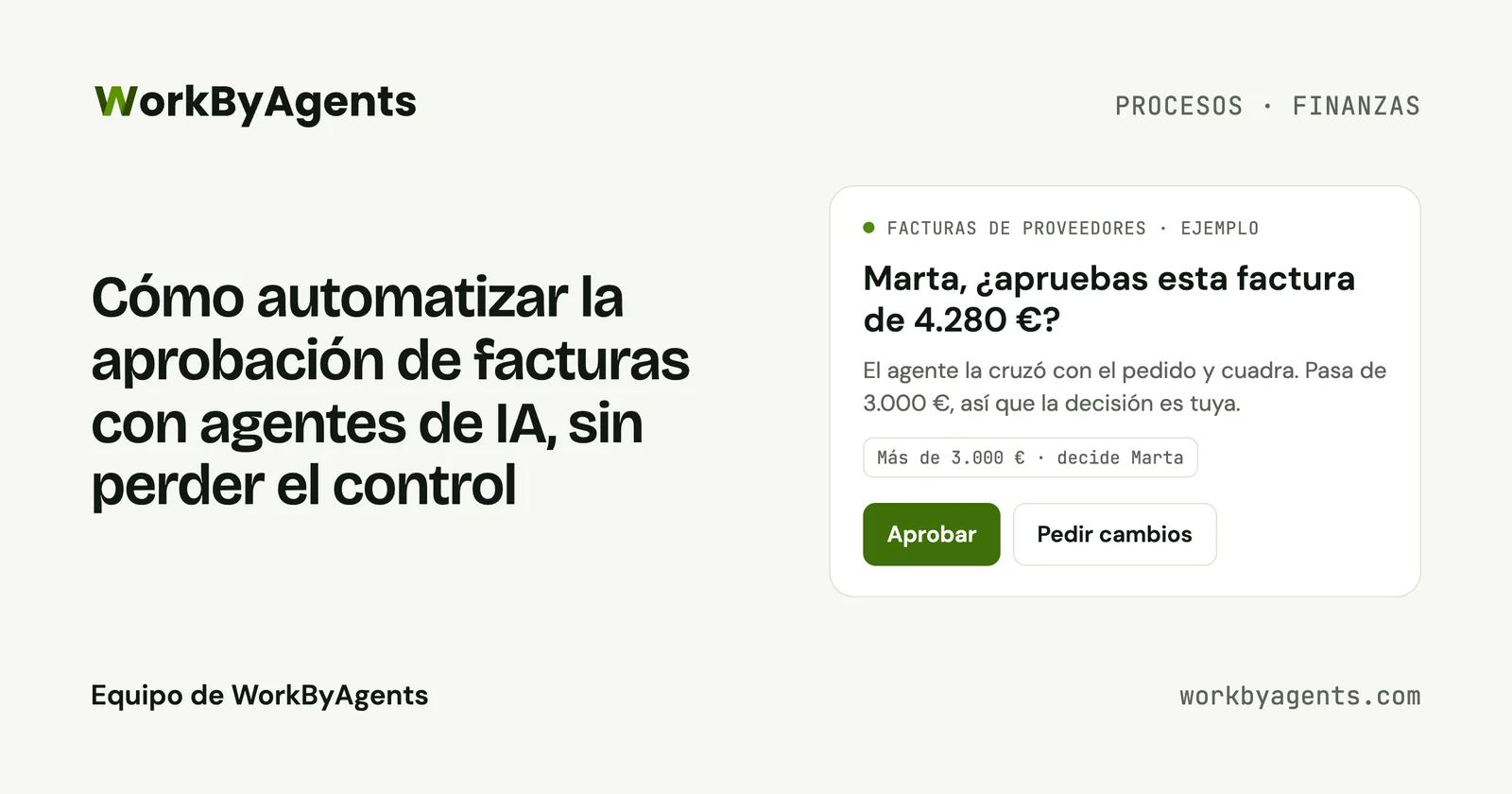
- Define the decision rules. For example, “over €3,000 Marta decides”. Also choose which channel she'll answer on: Slack, WhatsApp or web.
- Simulate with real cases. Run the process with past invoices and review the trace.
- Publish and improve. Activate the process and let the orchestrator suggest rules based on what you approve.
Tip: start with a single supplier or one type of invoice. Expand when the simulation comes out clean.
How do you test it before publishing?
With a simulation that runs the real process and intercepts any write.
Simulation uses test cases and goes through the same steps as the real process, but writes nothing to your ERP and sends nothing. You get the trace of each step and the list of what would have been done.
- Amount
- 4.820,00 €
- Job order
- JO-882 · matches
- Flag
- 8% above supplier average
Ábaco and Lupa, 09:11
Figure 2. This is how a decision arrives on the web or Slack, with its context. It is the Inbox's real card: you can press “Approve”.
What are the risks and how are they controlled?
The main ones are reading errors, excess autonomy and sensitive data.
- Reading errors: mandatory matching with the PO and human decision on any difference [4].
- Excess autonomy: amount limits and reviewable autonomy levels [3][4].
- Data protection: data processing agreement and per-company encryption [2].
- E-invoicing: check what the regulation applicable to your company requires [1].
Frequently asked questions
Sources
- Law 18/2022 of 28 September on the creation and growth of companies (B2B e-invoicing) BOE · See the consolidated version · URL to be verified
- Regulation (EU) 2016/679 (GDPR), arts. 22 and 28 (automated decisions and processor) EUR-Lex · URL to be verified
- NIST AI Risk Management Framework 1.0 (AI RMF), human oversight and risk management NIST, 2023 · URL to be verified
- OWASP Top 10 for LLM Applications, “Excessive Agency” OWASP · URL to be verified
- WorkByAgents documentation: simulation, decisions and audit workbyagents.com/docs · pending publication